
CASE STUDY:
Punch & Inject Tool Restores Zonal Isolation to Keep Well Online
Pressure cycling over three years degraded a previous sound bond inside a gas storage well. Renegade deployed the Punch & Inject Tool to deliver resin into micro-annular channels where conventional methods couldn’t reach, keeping the well in service.
CONDITION:
A vertical gas storage well with a production string inside intermediate casing had been operating under routine injection and withdrawal cycles for decades. A three-year-old bond log showed static cement in place, but a recent isolation log (July 2025) showed induced micro-annular channels.
Gas storage wells are held to strict federal regulations (API RP 1170/1171) requiring demonstrable zonal isolation barriers under static conditions. At the current state, the well did not satisfy those requirements.
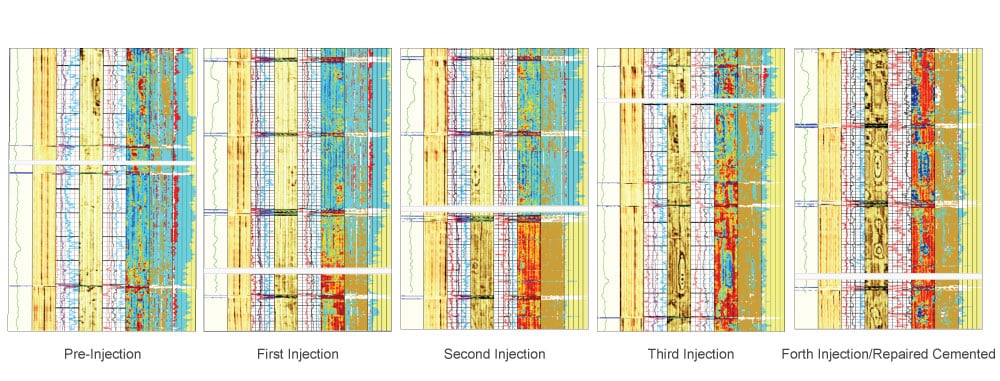
» Pre-injection bond logs showed a compromised interval where gas migration had created a loss of zonal isolation. After targeted resin placement, the post-injection bond response showed improved fill through the damaged channel. Follow-up isolation scans at 0 psi and 2,000 psi confirmed the repaired interval held under pressure, demonstrating restored isolation and allowing the well to remain in service.
PROBLEM IDENTIFICATION:
Subsequent isolation scans showed micro-annular channels between the production string and intermediate casing across approximately 200 ft of the target interval. The differential movement of the steel casing, which has elastic memory, against the cement, which does not, creates these micro-annular channels.
SOLUTION & RESULTS:
Renegade deployed the Punch and Inject Tool via crane-assisted e-line without a rig, explosives, or cement. The operation was fully self-contained. Two injections across four punch points delivered less than four gallons of resin directly into the tight micro-annular channels at approximately 10,000 ft. and 9,000 ft.
Between each injection, bond logs can immediately track the rising level of resin and confirmed progressive fill upward through the treated zones.
Post-job isolation scans confirmed a dramatic improvement, with zonal isolation restored to above 9,000 ft. The damaged cement interval was remediated and the barrier re-established. After a 96-hour cure time, the well was restored to service, avoiding plug and abandonment, and maintaining a critical long-term storage asset.